Textuality vs. Orality
Multimodality
A Brief History of Multimodal Texts
Writing & Technology
What does any of this have to do with First-Year Writing?
CCCC Principles for the Postsecondary Teaching of Writing
7. Sound writing instruction integrates technological developments.
Writing has always been a technology, and technological developments are themselves worthy of inclusion and study as part of the practice of writing. Writing teachers are in the best position to handle ethical use of such technologies and demonstrate how technologies can help writing be lively, powerful, and rhetorically effective. Texts are inherently multimodal. Composing draws on rich data sets of knowledge and memory that require ethical frameworks for use, and LLMs like Chat GPT, LaMDA, and Orca extend the need for such frameworks and critical reflection.
For example, economically privileged students have always had the ability to pay ghost writers, so we remind educators that LLMs have not altered the possibilities of academic dishonesty, only changed its socioeconomics and accessibility. Various concerns about A.I. underscores the need for this statement because the concerns often confuse the purposes of writing instruction by placing undue emphasis on the product rather than the process (see Principle #5). Just as mathematicians were wary of allowing the classroom use of powerful scientific calculators developed in the 1970s, writing instructors are currently wary of contemporary computing power and its effects. While academic dishonesty is possible in any system and LLMs can produce highly readable summaries and positions with evidence, an emphasis on process and an ongoing dialogue with students about their reasons for changing drafts is instruction that clearly focuses on student learning rather than rote textual production. As with mathematical problems in trigonometry or calculus, the emphasis is less on the result and more on the ability of learners to show their work.
Because computing power does not show signs of decreasing and since LLMs are being incorporated into search engines and other tools upon which research depends, blanket prohibitions against such tools seem short-sighted and even counter-productive. Instead, teachers should help both colleagues and students critically examine their own uses, collaborate with learners and community members on the ethical dimensions of these novel tools, and develop common community understandings of how these tools affect learning. We expand this to other forms of expression to include multimodal and multiliteracies instruction congruent with the other points we lay out here. Web texts, video, podcasts, graphic novels, and other modes of composition should be included alongside written composition because they require similar composing processes (see Principle #2).
Learning outcomes?
ENGL 1A and Stretch
1. demonstrate knowledge and understanding of the content, context, effectiveness, and forms of written communication;
2. perform essential steps in the writing process (prewriting, organizing, composing, revising, and editing);
3. articulate an awareness of and write according to the rhetorical features of texts, such as purpose, audience, context, and rhetorical appeals;
4. integrate their ideas and those of others by synthesizing, explaining, analyzing, developing, and criticizing ideas effectively in several genres; and
5. demonstrate college-level language use, clarity, and grammatical abilities in writing.
ENGL 1B
1. analyze and understand works of philosophical and humanistic importance, including their temporal and cultural dimensions;
2. explore and articulate their own subjective aesthetic and intellectual responses to such texts;
3. analyze and assess ideas of value, meaning, and knowledge, as produced within the humanistic disciplines; and
4. research and write effective analyses of works of the human intellect and imagination.
ENGL 2
1. locate, interpret, evaluate, and synthesize evidence in a comprehensive way, including through library research; and integrate research findings into oral and written arguments through appropriate citation and quotation;
2. use a range of rhetorical and logical strategies to articulate and explain their positions on complex issues in dialogue with other points of view;
3. identify and critically evaluate the assumptions in and the contexts of arguments; and
4. use inductive and deductive logic to construct valid, evidence-supported arguments and draw valid conclusions.
But doesn't this water down the curriculum? Isn't this just selling out and abandoning "rigor"?
First, I should be up-front that I *hate* rigor. I'll spare you the soapbox speech, but in my experience, "rigor" is tossed around very unrigorously. But that's beside the point here.
The kind of alphabetic writing traditionally taught in composition classes continues to be important and useful to students. Unequivocally. But ... there has always been a pretty serious problem with it in that it has nearly always relied on what I'm going to call the "hermetic fallacy."
We've long pretended--maybe we even have to pretend--that there is "good writing" or "correct composition" that exists apart from the sturm und drang of culture, history, technology, changes in language (including grammar, usage, and punctuation), human foibles, etc.
Except, of course, it doesn't. There is no "good writing" in general. Writing is always particular. And at this particular moment, the majority of writing that people do is inextricable from digital technologies.
Digital literacy is not the present or the future. It's implicated in the totality of human literacy. The tools change, the contexts and purposes and audiences change, the writers change, the languages change. But the central questions remain relatively constant:
- How can we learn to consume texts in critical, engaged, meaningful ways?
- How can we learn to produce texts in critical, engaged, meaningful ways?
- How can we help others learn to consume and produce texts in ways that will serve them in their lives, not just in their FYW classes or majors or careers, but in their lives?
Digital literacy and multimodal composition can, absolutely, be taught unrigorously. So can linguistic, alphabetic writing. Trust me, I've taught both unrigorously. But teaching digital literacy and multimodal composition can be equally or more rigorous than traditional writing. How?
Simply design all teaching and learning around our guiding questions and learning goals--which are, themselves, abstract, ultimately unanswerable, and ever-changing.
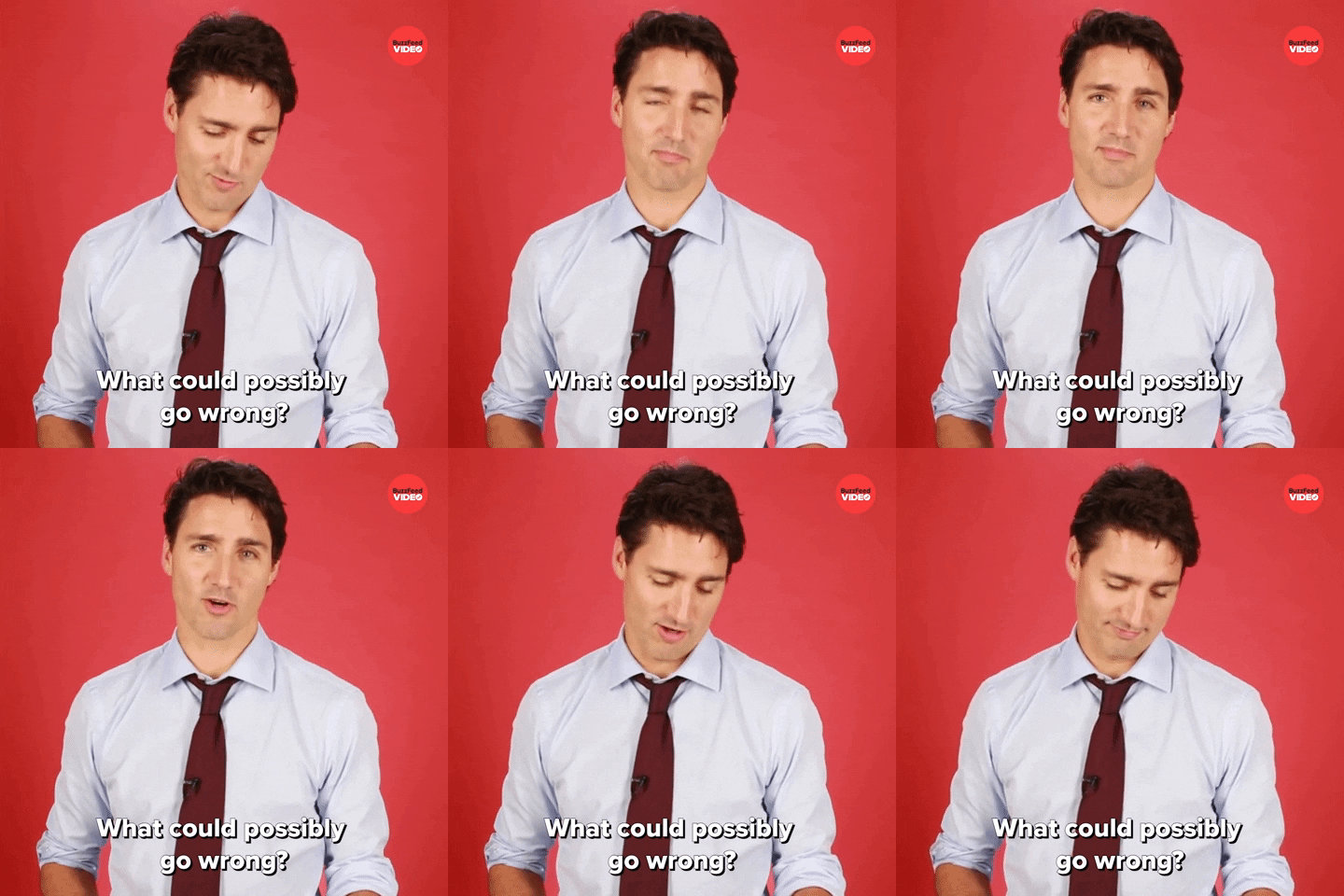
Okay, but ... teaching, like writing, exists in the sturm und drang of culture, history, technology, changes in language (including grammar, usage, and punctuation), human foibles, etc. We do the best we can, and we keep doing the best we can, even as the world keeps changing. ¯\_(ツ)_/¯
Composition: the arts of preparing and arranging texts (across a variety of modes) to achieve communicative goals
Rhetoric: the arts of effective reading, writing, speaking, and listening
Technology: the application of conceptual knowledge (including material and digital knowledge) to achieve practical goals
Critical Thinking: the ability to interpret, evaluate, and analyze information to form considered judgments
Asset-based pedagogy: teaching methods where students' unique strengths and differences are treated as resources that can be called upon to for communal learning
Large-Language Models ... Text/Content Generators ... A.I.
Linguistic texts are *not* passé, inconsequential, or even endangered. Teaching writing is *not* passé, inconsequential, or even endangered. We're not going out of business any time soon. At the same time, written "products" are becoming cheaper and easier to conjure with minimal human input. New circumstances demand new skills and practices. We can lament. There's genuine value in lamenting.
But we can do other things as well. Chief among them, we can refocus on helping students develop flexible writing/composing processes. Not simply processes that result in finished written products, but processes they can carry with them to new writing, learning, and composing tasks that can, hopefully, serve them well as circumstances continue changing.