In This Issue
1 • Going for Gold – Finding excellence in competition
2 • Dreaming Big – Preparing a path for the future
3 • Transformative Spaces – When school facilities become learning tools, magic happens
4 • Keeping Athletes in the Game – The importance of injury prevention to keep student-athletes thriving, healthy and happy
5 • Choosing What to Learn – An ES initiative allows students to explore new interests and follow personal passions
6 • Embracing Sustainability – Taking steps to shape a better world
7 • Building a Sense of Belonging – A special bench on campus provides space to make a friend
8 • WIN Time – Elevating personalized learning at FISW
9 • Celebrating Learning – Grade 1 families come together for a shared learning experience
Going for Gold
Finding excellence in competition
Many parents employed in for-profit industries are familiar with the need to closely protect company secrets. In fact, it is not uncommon to have contracts that include agreements to prevent an employee from taking key learnings or clients with them to a competitor. Fortunately, as a non-profit Foundation, FIS is in a very different situation.
FIS frequently welcomes visitors from local and international schools across the world to learn from the way in which we engage students and our broader community. In addition, FIS faculty are often presenters as conferences across Europe and further afield to freely share our philosophy and practices. While we are very ambitious in our vision to be a global leader, we enjoy the opportunity to collaborate with other schools to further our mutual aim of impacting the lives of children.
Recently I have been part of forming a group of other international school leaders here in Europe. We represent the prominent schools of Paris, London, Zurich, Brussels and elsewhere. And just as our respective students compete against one another in ISST sports, there is healthy competition amongst this leadership group to make sure our school is at the forefront of international education. As I listen to my peers talk about their school’s IB scores, facility improvements and employee recruitment practices, I applaud and support their progress, but it also ignites in me a competitive spirit.
I believe both students and schools can use the high performance of peers to help move themselves to the “next level.”
In some circles, there is a belief that competition and education cannot go hand in hand. Of course, it is clear that unhealthy competition between students leads to high levels of stress and a breakdown in school spirit. But I believe both students and schools can use the high performance of peers to help move themselves to the “next level.” On a recent Saturday, as our JV Boys Volleyball team competed for the ISST gold medal on our home court, I watched two great teams compete neck-and-neck, each forcing the other to play at increasingly higher levels of competence.
That is the school I want to lead – one that is not afraid to help its peer schools succeed, but will measure ourselves against the very best. It is an attitude that has a direct impact on the success of our students and teachers, who also are caught in the strong tide of a school with a tradition of excellence. Our mission statement challenges us to be “the leading international school,” and it’s a target we take seriously. (And yes, FIS did win that gold medal in the final match.)
Dr. Paul M. Fochtman, FIS Head of School
Dreaming Big
Preparing a path for the future
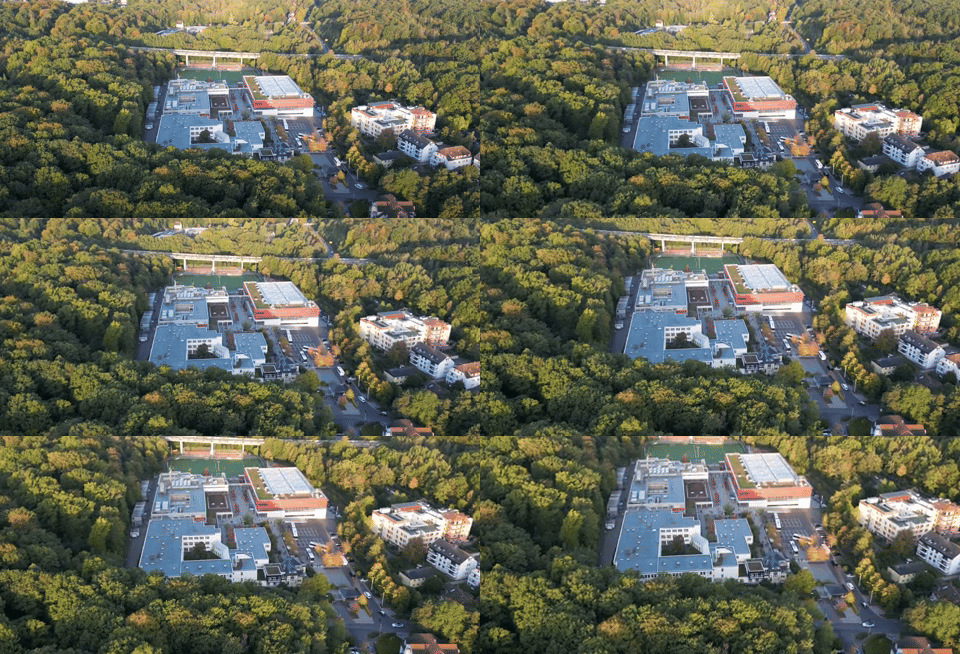
It has been said that only by “dreaming big” can lofty goals become reality. Greatness is not achieved by aiming for only an “acceptable” result. Just as our students will not ace their exams if they are merely trying to pass, our school has to be equally ambitious in preparing our path for the future.
There are two primary ways FIS does this. The most obvious is to provide our staff with professional development that keeps them abreast of the most advanced teaching strategies available. The adults we put before students at FIS are our most valuable asset and their skillsets directly impact those acquired by students. In light of this, FIS brings in renowned experts on a variety of topics each year to provide on-site seminars, and we also send scores of our professionals to attend leading conferences around the world.
This not only includes academic areas. We also engage experts on topics critical to the social and emotional health of our community. While I am grateful that my children are taught by highly capable and well-trained teachers, to allow these teachers to maximize their abilities, they need the facilities and resources that are equally advanced. That is why our Board continues to strive toward developing both of our campuses into environments that are of a world-class standard.
FIS brings in renowned experts on a variety of topics each year to provide on-site seminars, and we also send scores of our professionals to attend leading conferences around the world.
Yes, if we were only to consider the Frankfurt region, our school would already be at the top of its class. And while this standing is to be celebrated, the reality is that our students will become adults in a highly competitive world. If they are to be prepared for life beyond FIS, be it in fields of medicine, the arts, STEM, or education, they will not feel the need to “catch-up” because their learning has been built upon a rock-solid foundation here at FIS. As a school where parents partner closely with our educational leaders, we welcome you to “dream big” with us as we move into another exciting era at FIS.
Julia Heraeus-Rinnert, Chair, FIS Board of Trustees
Transformative Spaces
When school facilities become learning tools, magic happens
During the 2023 summer months, while most were enjoying the sun and travels, inside the Oberursel Campus Elementary School, exciting changes were underway. Major renovations took place, transforming wide sections of the school into a hub of vibrant, cutting-edge learning spaces that are not only visually stunning but are also deeply rooted in pedagogy. Students returned in August to a brand-new library, Design Technology/Science and Lego/Robotics spaces, a state-of-the-art kitchen, and other collaborative learning spaces.
The heartbeat of the renovations was a commitment to connecting learning spaces to the curriculum while fostering creativity, collaboration, and a sense of belonging. As Elementary School Principal Dr. Jean-Marie Kahn explains, “there was an opportunity to update these once isolated areas and bring learning alive. Together with teachers, we are now able to connect spaces to the curriculum. Teachers and students can circulate fluidly between these vibrant hubs which not only look impressive, but also function as dynamic tools for learning.”
The newly designed spaces encourage collaboration and interaction. Teachers find themselves naturally gravitating toward collaborative planning, sharing ideas and resources to enhance the learning experience for their students. Building, designing, making, remaking and modifying are all activities that students can engage in as they solve problems, complete rich tasks or challenges in the renovated manipulative haven.
Enter the makerspace, an area for hands-on exploration and creation. Equipped with tools, materials and a dash of imagination, students delve into the world of prototyping and brainstorming. Add to this, a LEGO robotics learning space which sparks joy and ingenuity, connecting play to essential 21st-century skills.
The newly designed spaces encourage collaboration and interaction.
At the heart of it all lies a central gathering area, with a capacity for larger groups. This space is more than just aesthetically pleasing; it serves as a focal point for announcements, presentations and collaborative projects. Its high visibility ensures that every student feels like an integral part of the community. It allows for students to observe peers in action and formulate questions, suggestions and new ideas or engage in meaningful conversations.
The renovated spaces support the four thinking models: research, design, creativity, and scientific, which teachers are encouraging students to utilize to foster agency and autonomy in their experiences. Students are now immersed in open-ended choices that promote critical thinking, independence and personalized approaches to learning. The new environments also provide more options for independent work to be freely accomplished.
The new library is a sanctuary of stories, embracing the power of diversity and inclusivity. With a special section dedicated to Everybody books, it sends a powerful message—that in this space, everyone belongs. Picture books from various cultures and languages enrich the English Language Acquisition (ELA) curriculum and ensure accessibility no matter the language skills. The carefully curated collection of multilingual books also promotes the practice of translanguaging which students are engaging in under the guidance of their teachers, connecting students to a world of words.
In the wake of these renovations, FIS stands as a testament to the transformative power of intentional design in education. The school has evolved into an ecosystem where every corner is a potential learning space, and every moment is an opportunity for growth. As students step into this new academic space, they are not just entering classrooms, they are stepping into a world of endless possibilities where the joy of learning knows no bounds.
Adriana Ardolino, FIS Parent
Keeping Athletes in the Game
The importance of injury prevention to keep student-athletes thriving, healthy and happy
What is an Athletic Trainer? You might know other names for athletic trainers, such as athletic therapists in Canada, or sports therapists and sports rehabilitators in the United Kingdom. Athletic trainers and therapists are high-level first aiders, physical therapists, and orthopedic specialists all rolled into one. We work both in clinics and court- or pitch-side. Some athletic trainers work in professional sports or in college or university sports, but many work in schools like FIS.
Frankfurt International School has a robust athletics program, with over 50% of Upper School students participating in athletics throughout the year. This past fall season alone, over 400 students participated in the FIS Athletics program. Through any given season, around 25% of those athletes will need help with an injury that limits them playing their sport. While athletic trainers are well-versed in caring for injured athletes, one of the most important aspects of athletic training is working with coaches and athletes to reduce injury risk and prevent injuries where possible.
One way that FIS helps to reduce injury risk is the three-season sports program. Research outlines the benefits of young athletes playing multiple sports throughout the year for reduction in injury risk and increased sports performance. When young people have the opportunity to play multiple sports they gain new skills, work different muscles, and avoid overuse injuries. The professional sporting world knows this too: since 2014, nearly 90% of the United States National Football League’s (NFL) drafted players were multi-sport athletes in high school. The three-season sports program at FIS helps build great athletes while also preventing injury.
We know that athletes who overcome injury or avoid injury are more likely to carry on sport beyond their time at FIS.
Another way that FIS Athletics is working to prevent injury is through introducing strength training to more athletes. Strength training is possibly the best way to prevent injuries in athletes. In certain youth populations, such as untrained youth and young girls, studies have shown up to 68% reduction in injury risks through strength training programs. Athletes who strength train are better able to increase their sports performance. Not only does strength training result in stronger and better athletes, we also know that strength training helps build stronger bones – a benefit that lasts well beyond youth and into adulthood. Strength training is being rolled out to athletes in various teams, primarily with high school teams. We build strength training sessions around the specific sport, with coaches’ input for exercises.
One of our biggest ongoing efforts to reduce injury risk has been training coaches and athletes in warm-up techniques. Research shows that including neuromuscular components in warm-ups for any sport can help reduce injury risk in youth athletes. Neuromuscular components include:
- Balance exercises, which are helpful for preventing ankle sprains
- Plyometrics, such as hop and jump exercises that can help train an athlete to run faster
- Agility training, including quick stops and changes of direction to help prevent knee injuries
Our Warriors Warm-Up includes all of these components and other exercises tailored to each sport.
While not all injuries can be prevented, we seek to reduce risk wherever possible. Reducing injury risk takes time and effort, not just from an athletic trainer, but from coaches, families, and especially athletes. We know that athletes who overcome injury or avoid injury are more likely to carry on sport beyond their time at FIS. It’s even part of our Athletic Department Philosophy: “fostering a lifelong love of sport.” With community support, our athletes can achieve that, staying active beyond their high school years, and most importantly, staying healthy, thriving, and happy.
Megan Hodun, PhD, ATC, FIS Athletic Trainer
Choosing what to Learn
An ES initiative allows students to explore new interests and follow personal passions
In my first article for FIS World, I explored the partnerships nurtured between parents and the school. During multiple principal partnership meetings, Elementary School families learned about FLECKS time. Piloted last year with Grade 4 and 5 students, FLECKS time is an innovative concept expanded this year to include Grade 3 as well. I had the privilege of chatting with Primary Years Programme (PYP) Coordinator Christine Ishii to peek behind the scenes of the FLECKS program.
True to its name, “Flex” (short for “flexible”) time was rebranded this year as FLECKS (Fun, LEarning, Creativity and Community, Kindness, OpportunitieS). All Grade 3-5 students are given the flexibility to make learning choices for their weekly FLECKS period. Options involve language, physical, creative or other learning activities. At the beginning of the school year, students were introduced to all of the FLECKS offerings before choosing their top five interests. Significant effort was made by the Elementary School to place each child in three of their choices, which they will enjoy for 9-10 weeks at a time in three terms over the course of the school year.
A key (perhaps the key) tenant of this initiative is the choice aspect – each student’s choice. Often, elementary-aged children have limited choice regarding how their learning may look during the school day. According to organizers, FLECKS time “is an opportunity for students to explore new interests, follow their personal passions and apply their learning to new situations.”
That is why parents do not receive the menu of choices available to their children. This was discussed at multiple ES parent partnership meetings; some parents (myself included) strove to learn more about the possible choices for their children in hopes of guiding them toward specific activities. But FLECKS organizers emphasized the importance of student agency free from external pressure.
I was pleasantly surprised when my son enthusiastically shared he had received a spot in a bicycle riding class; that was the class I had hoped he would choose. At that moment, I realized it meant so much that he chose it for himself without my input. I have since learned that part of the FLECKS program requires the students to write about themselves as a learner. This is much more impactful and genuine when the students are choosing what they learn.
When my son came home with a pair of yarn balls, I asked what they were; his friend learning Knitting and Sewing made them and gave them to my son to test his model rocket. That’s the beauty of this program: students have the opportunity to be open minded (in exploring activities with which they are unfamiliar), risk takers (by making their own choices), and balanced (by choosing from a rich variety of topic areas).
I recently spoke to a Grade 3 student whose FLECKS offering this term is Google Ninja, a program focused on enhancing unique Chromebook and other Google skills. The student shared with me, "At my old school it was just teach, teach, teach. This school is more fun." I didn’t tell him that he was actually being taught quite a lot. He will figure that out at the end of the FLECKS term when all of the students complete self-reporting for assessments to reflect on the connection to academic skills and disciplines, their connections to our school values, the most significant thing they learned, and how to use that learning in the future.
Susan Robbins, FIS Parent
Embracing Sustainability
Taking steps to shape a better world
In the dynamic world of education, Frankfurt International School emerges not only as an educational institution; it is on a transformative journey, intertwining sustainability into its very fabric. Imagine a school that doesn't merely discuss a better world but actively shapes it – where lessons become stepping stones toward an eco-conscious future, embedding sustainability in accessible ways, making it tangible for students and implementing incremental changes that ripple into a lasting impact.
From Vision to Action
To comprehend FIS's sustainability commitment, a rewind to its roots is crucial. Sustainability has been a priority since before 2015 when large scale projects such as 100% renewable electricity and organic waste collection procedures were already in place on both campuses. Since then, the school’s efforts to form a well-rounded program have consistently evolved. In 2019, the school convened a diverse group of stakeholders interested in supporting the school’s vision for a more comprehensive approach to environmental issues. Mapping historical efforts to the United Nations Sustainable Development Goals (SDGs), the FIS Sustainability Council provided a clear overview of its path, guiding future planning and goal setting. In 2020, sustainability was incorporated into the school’s strategic plan to serve as a guiding principle, rather than a separate initiative.
The Sustainability Council, composed of parents, teachers, administrators, and students, ensures FIS stays at the forefront of sustainability efforts. It's not just about discussions; it's about tangible actions that are spread across all areas: waste separation, policy formulation, environmental protection, social commitment, economic responsibility, and more recently, learning and operations.
In classrooms, sustainability thrives as a living entity, beyond books.
Shelly Kelly, FIS Board of Trustees member and Buildings and Grounds Committee Chair, explains how FIS most recently has begun charting its sustainability course through a detailed framework, the Compass Framework, which guides every aspect of the program. “Beyond a concept, it's a way of life ingrained in every facet of FIS by means of ‘workstreams’ (working groups). Sustainability is not an isolated endeavor; it's an all-encompassing approach where each element points towards a more sustainable future."
In classrooms, sustainability thrives as a living entity, beyond books. Students learn about the UN Sustainable Development Goals (SDGs); how a circular economy works and supports the program’s goals, and in what ways they can become champions of change. Real-world environmental challenges are embedded in the curriculum more and more, prompting students to actively contribute to a future they wish to inhabit. This approach is not just about understanding these challenges but actively preparing students to tackle them with innovation and creativity.
Maryam Hilger, FISO’s PS/ES Outdoor Learning teacher explains: “Outdoor learning plays a crucial role in supporting sustainability by fostering a deeper connection between students and the natural environment. Through hands-on experiences, such as planting food or exploring local ecosystems (forest, meadows, ponds), students gain knowledge and a practical understanding of ecological principles and sustainability practices. All these experiences outdoors will hopefully lead to an emotional bond with nature and our goal with this immersive approach is to cultivate a sense of responsibility and stewardship for the planet, encouraging future generations to make environmentally conscious decisions.”
Ashley Hopper, FISW’s Elementary Science Coach and STEAM Lab Teacher shares that “teachers use Science units to promote lessening human impact on Earth and talk about interactions between humans and Earth where students develop their ideas about how to better interact. We use recycled materials for most of our building challenges and talk about material use. We also promote the use of natural materials from the Outdoor Learning Area.” Every action counts.
Sustainability at FIS is no longer an idea; it is part of the school’s culture.
All Student groups are connected to the program’s efforts. Student-led initiatives, from the PS/ES Earth Rescue Club to FISW’s Recycling Change Makers Club and the Upper School’s Service Groups all align with the UN’s SDGs. Sustainability at FIS is no longer an idea; it is part of the school’s culture.
Recognizing the crucial role parents play in shaping a sustainable school culture, FIS is pioneering efforts to engage them in this transformative journey. One of the five dedicated workstreams within the Sustainability Council connects parents with broader sustainability goals. FIS doesn't just nurture students; it fosters a community-driven approach to sustainability where every family contributes to the green vision and it seeks to harness the diverse skills and interests of parents, creating a community-driven approach to sustainability.
It Takes a Village
The school's commitment to sustainability is not a fleeting promise but a vision unfolding. By embracing transparency, the Council hopes to build trust among students, parents, staff and the broader community, and to form the foundation for a continued collaborative and supportive sustainability culture.
By aligning teaching practices, implementing an efficient and comprehensive framework across all layers of the school community, engaging parents, and fostering accountability, FIS is creating a powerful roadmap to reach its goals and build a better future.
Adriana Ardolino, FIS Parent
An invitation stands for the entire community to actively participate in shaping a sustainable legacy for generations to come. To get involved, contact sustainability@fis.edu. For more information about Sustainability at FIS, click here.
Building a Sense of Belonging
A special bench on campus provides space to make a friend
“You can be a friend no matter what,” says Hannah Houser, a Grade 2 student I had in my class last year. Wanting to make sure there was a way for students to find a friend to play with if they didn’t know who to ask, she set to work establishing a “Buddy Bench” for the school. A Buddy Bench is a designated seating area on school playgrounds where students can sit if they are feeling lonely, in need of a friend, or just want someone to talk to. It acts as a visual cue to encourage empathy and inclusivity among students.
Her idea became a reality through the collaborative efforts of the students in our class last year, Hannah’s mother Christa, our former FIS Assistant Principal Dawn Darling, and our team of FIS Hausmeisters. Thanks to Hannah’s initiative, we have recently installed a Buddy Bench on the Oberursel campus. This addition to our school is not just a simple piece of furniture; it's a symbol of our commitment to nurturing friendship, empathy, and inclusivity among our students.
One of the primary reasons for installing the Buddy Bench was to promote friendship within our school community. “The Buddy Bench can bring people together,” Hannah says. “Even making it brought friends together.” In order for students to feel welcome and connected, Hannah and her mother made sure that the phrase “Make a Friend” was represented on the bench in some of the many languages spoken at FIS. By providing a dedicated space for students to seek out friendships, the hope is to foster a culture of inclusivity.
This addition to our school is not just a simple piece of furniture; it's a symbol of our commitment to nurturing friendship, empathy, and inclusivity among our students.
“School should feel safe and be a place to have fun. I don’t want any kid to feel lonely at school,” Hannah explains. The Buddy Bench helps teach empathy. The goal is for students to learn to recognize when someone is in distress and take the initiative to reach out and be a friend. This valuable life skill extends beyond the school and helps students develop strong interpersonal relationships building community and kindness.
By promoting inclusivity, encouraging empathy, and facilitating new friendships, the Buddy Bench shows FIS’s dedication to building a strong and interconnected community. It also shares the Elementary School's values and commitment to creating a supportive and nurturing community.
I am proud of Hannah for bringing this idea to FIS and leaving it as a gift before moving back to the US with her family at the end of last year. Hannah’s mother reflects on the journey as well, “I liked watching Hannah and her classmates figure out this project. She learned so many things: how to flesh out an idea, how to make a presentation, how to inspire people to join in, and how to complete a project. Our family is also happy to have been able to leave something for the FIS community; we are so grateful for our time at FIS and the amazing and supportive community we had in Germany.”
Amanda Naimy, FIS Elementary School Teacher
WIN Time
Elevating personalized learning at FISW
In an educational landscape that is responsive to students' unique learning needs, FISW proudly introduces "WIN Time" – “What I need” time – an innovative and transformative learning initiative that epitomizes the school's commitment to personalized education.
WIN Time develops as a dynamic and adaptable curriculum designed to suit each student's individual educational needs within a 30-minute daily window on their calendar for seven days out of an 8-day cycle. Day H, also known as FLEX day, is the eighth day and is a full day devoted to personalized learning projects, and local and global connections.
Our WIN Time program excels in providing targeted academic interventions, particularly in critical areas such as mathematics, reading, and writing. These sessions are meticulously designed and informed by a thorough examination of student performance data. Our teachers assess student progress on a regular basis, identifying specific areas where children may benefit from further support and/or challenge, and ensure that students receive the guidance and resources needed to flourish academically.
Notably, WIN Time is not restricted to academics. Students can use this time to complete assignments, seek extra help from teachers, or concentrate on personal projects, including passions such as art or technology. It allows children to explore and develop skills outside of the constraints of a traditional classroom.
WIN Time also provides a variety of enrichment activities meant to challenge kids. Students are enabled to pursue hobbies and participate in intellectually engaging activities that exceed standard curriculum through math enrichment programs, German language challenges, and a wealth of extracurricular possibilities.
WIN Time in Middle School provides learners with options that best match their needs. It caters to all students and offers interventions for those who need it the most, whether they are engaging in subject-based groups, seeking support in various classes, or using Study Hall. With occasional guidance from their teachers, students plan their WIN selections weekly, demonstrating an effective incorporation of sessions and a more manageable schedule compared to last year’s iteration of this novel addition to their academic program.
WIN Time not only serves as the school's commitment to cultivating a thriving and enriching educational experience for everyone, but also as a testament to FISW's unwavering dedication to personalized learning and nurturing each student’s unique potential.
WIN Time options in the Middle School include Math help, reading and writing interventions, Math enrichment, LEGO Spike, and Study Hall, with laptop usage carefully monitored and a maximum of 15 students in each Study Hall session.
In the Primary and Elementary divisions, WIN Time is a scheduled time every day (excluding Day H) where children who require additional services are seamlessly integrated into Learning Support, English Language Acquisition, or supplemental German Language Integration. This strategic approach avoids disruptions to the learning process and allows teachers to quickly arrange tailored interventions for children with similar needs. Additionally, this has bolstered our support teachers to provide individualized interventions at times in the day where all students are moving spaces for personalized learning, removing the stigma that some may feel when being asked to leave a homeroom lesson for particular learning interventions. Those students who may not be receiving specific interventions use this time to continue working on PYP Unit of Inquiry projects or tasks, tinker in the STEAM lab, engage in math challenges, and more.
The flexibility of WIN time enables students to explore personal interest-projects, such as delving into WeVideo techniques, engaging in tinkering activities, organizing and recording Student Newscasts for our Community Assemblies, or experimenting with batteries and cardboard cutting. This not only enhances their learning experience, but also encourages self-directed exploration of topics of interest.
A notable success story within the WIN time framework is one Grade 4 student who has been expanding his understanding of WeVideo, an online video editing application, through his own self-directed learning time. FISW Technology Coordinator, Angi Jochum, shares, “He discovered how to creatively use the 'screen in screen' functionality to display four videos simultaneously, producing a very unique and special result to his video productions (as seen below). He has become one of the Grade 3/4's "resident experts" on WeVideo as a result, sharing and teaching his classmates how to incorporate the various features in creative ways.”
WIN Time's success is determined by each child's academic and overall growth. Students gain autonomy and responsibility by exploring their own interests, participating in extracurriculars, and seeking help when needed.
As WIN Time enters the next phase of its journey, the school remains dedicated to providing ample resources and mentors. The commitment to maintaining small group sizes in interventions and study halls ensures that each child receives the attention and support necessary for their growth.
In this way, WIN Time not only serves as the school's commitment to cultivating a thriving and enriching educational experience for everyone, but also as a testament to FISW's unwavering dedication to personalized learning and nurturing each student’s unique potential.
Gioia Morasch, Associate Principal, FISW
Celebrating Learning
Grade 1 students and their families coming together for a shared learning experience
As part of the FIS Mission statement, we endeavor to be a “family-oriented” school. While this extends to community events and welcoming parent volunteers to be actively engaged on campus, it also includes a shared celebration of student learning. A perfect example of this commitment to a shared experience occurred earlier this year when Grade 1 families were invited into classrooms in connection to their students’ Unit of Inquiry, “How the World Works.”
The event was a dynamic culmination of the students' exploration into the central idea of the unit: "People use their understanding of materials to create complex structures." Throughout the unit, students delved into the related concepts of structure, stability and design. They participated in a range of structural challenges such as building the tallest and most stable Lego tower and creating a stable house for a plush toy animal – inspired by the story of the Three Little Pigs. In doing so, they explored the properties of different materials and learned about different ways to connect them to create stable structures.
The highlight of the celebration of learning was an engaging and high-energy challenge that brought together students and their families in a unique and collaborative way. The challenge centered around the line of inquiry focusing on "designing and creating stable structures." The task was clear but exciting – each group had to work together to design and build a stable structure using only newspaper and masking tape. The ultimate goal was to create a structure strong enough to support a basketball for at least 20 seconds.
“Having families join students for the building challenge not only strengthened our sense of community, but it allowed the children to act as teachers, using their home languages to teach and demonstrate the building techniques they had learned as part of the unit,” said Grade 1 Team Leader, Bonnie Winn.
The challenge encouraged problem-solving skills, but also required effective communication and collaboration among the students and their families. All of the teams were immersed in discussions, brainstorming sessions and hands-on construction. The related concepts of structure, stability and design came to life as they experimented with different shapes, sizes and techniques to achieve the desired stability for their structures. “I had fun and I liked it because I made the tower stand for 20 seconds,” said Grade 1 student Leonardo. “I was happy because I saw my mum and I liked working with my family.”
The room buzzed with enthusiasm and creativity as families explored the possibilities of the materials at hand, fostering a shared understanding of the principles of architecture and engineering. Grade 1 student Clara said, “It was a lot of fun because I used many sheets of newspaper and stuck them together so that the tower could stand. I felt very proud that I made the tower in time.”
The joy on the faces of our Grade 1 students was evident as they worked side by side with their classmates and their families, and the collaborative event provided a wonderful opportunity to bridge the gap between school and home, fostering a sense of community and shared enthusiasm for learning.
Sarah Elliott, Primary School ICT Coordinator
Editorial:
Editorial Team and Contributors: Adriana Ardolino, Martha Boston-Majetić, Sarah Elliot, Megan Hodun, Gioia Morasch, Amanda Naimy, Susan Robbins
Photo Credits: Sarah Elliot, FIS Community, Lara Hodel-Mortensen, Lara Ingham, Ilia Katulin, Gioia Morasch, Susan Robbins, Evelyn Torrealba, Alex Westcott
Editor in Chief: Ryan Karr
Production: BT Zimpel