Table of Contents
Introduction | Press Release | Blog | Podcast | Podcast Cover | Logo | Brand Sheet | Social Posts | Long-Form Video | Reflection | Takeaways | References
Introduction
Company Overview
Google (google.com), a subsidiary of Alphabet Inc., is a global technology leader best known for its search engine, with influence extending beyond its knowledge base. Despite the rise of AI and other search engines, Google is today's primary search tool. Though Google does not publish its metrics, search monitoring websites SEMrush and Exploding Topics report that Google processes over 8.9 billion daily searches in 2025, up from 8.5 billion in 2024 (Thakur, 2025).
Google FirstPath is a conceptual, mobile-first college search platform built for first-generation (first-gen) and low-income students. It lets users filter schools by affordability, housing, transportation, technology access, and textbook support: turning a confusing search into a student-centered pathway.
Defining A New Game-Changing Subcategory
The subcategory is Access Search: a new space within Google’s product portfolio dedicated to advancing educational equity. According to Aaker, a game-changing subcategory involves a brand creating “must-haves” that deliver a superior user experience, maintain a strong connection with a vast and loyal customer base, and establish clear barriers that set it apart from competitors (Aaker, 2020, p. 25).
Similar to Google Flights or Google Travel, Google FirstPath provides a specialized search experience. While it is similar to Niche in helping students explore colleges, FirstPath stands out for its trusted Google brand recognition and its exclusive focus on low-income and first-gen students. Its human-centered storytelling and design provide a more inclusive and supportive pathway, featuring tools and guidance not available in resources like College Scorecard and College Navigator. According to Aaker, “a committed customer base is often the most important barrier to competitors muscling in on the new subcategory” (2020, p. 35). Google’s brand recognition sets it far apart from its competitors.
Signature Stories
The signature story for this campaign is a customer story centered on first-gen students and their lived experiences. The campaign uses emotional signature stories (Aaker, 2018, p. 55) of first-gen students Mia, Jordan and Ana in the blog, and focuses on Mia in the podcast and longform video to humanize key barriers (cost, connectivity and books) while showing FirstPath unlocking solutions. The stories are authentic, emotional, and strategically aligned with the brand’s mission to make education more equitable, using stories to inspire rather than facts to persuade (Aaker, 2018, p. 66).
Audience Profile
Demographics: Google FirstPath is designed for first-gen, low-income students, primarily ages 16–22, who are preparing to enter or transfer into college. Many come from families earning under $50,000 a year and whose parents did not attend college (U.S. Census Bureau, 2022; Redford et al., 2017). Aaker (2018) notes that strong stories meet people where they are. That guidance matters here. These students represent a significant share of the college-going population, with more than half identifying as Hispanic/Latino, Black or other underrepresented groups (First Gen Forward, 2021). A campaign that speaks to their experiences and aspirations has the chance to impact deeply.
Psychographics: Highly motivated but often overwhelmed by navigating college processes, these students desire upward mobility, financial security and family pride. However, they face systemic barriers. Limited parental guidance, affordability challenges and lack of internet access (Bryan et al., 2020) are some barriers first-gen students face. Since this audience heavily uses mobile-first platforms such as YouTube, TikTok and Instagram, a “higher purpose” signature story is ideal to advertise within their chosen media to capture their attention (Aaker, 2018, p. 68) since this audience prefers story-driven content over polished corporate messaging (Pew Research Center, 2022). Media habits make it critical for Google FirstPath to be mobile-optimized and low-data to show relatable narratives in which students can see themselves.
Geographic Information: The primary audience is located in the United States, with a concentration in urban and suburban areas where higher education access and first-gen student outreach programs are common. While the campaign is national in scope, we focus especially on regions with strong community college pipelines and high proportions of first-gen students, such as the Southeast and Midwest. According to Aaker, “customers can be effective partners in the development of breakthrough concepts” (2020, p. 123). Survey data from first-gen graduates suggest they would have benefited from a tool like FirstPath during their own college application process (The Pell Institute, 2024). This geographic focus allows the campaign to address real barriers in navigating the college admission process and connect with communities where first-gen enrollment remains below the national average.
Behavioristics: The target audience seeks practical, trustworthy guidance to overcome uncertainty around college admission, financial aid and campus life. They are motivated by relatable stories of success from peers who share similar backgrounds, and they respond best to content that provides clear, actionable steps, such as links to resources, checklists and personal testimonials. They often prefer mobile-friendly platforms and short-form content, but will engage more deeply with stories when they see a direct connection to their own challenges and aspirations. By including behavior pattern data (Aaker, 2020, p. 39), the tool targets the messaging to earn their trust. This insight shaped the decision to use narrative-driven blogs, relatable micro-podcasts and supportive social content to meet them where they already seek advice.
Campaign Objectives
The objective of this digital storytelling campaign is to raise awareness, foster inclusion and inspire action among first-gen college students and their supporters by highlighting authentic stories of perseverance and success. Through a coordinated mix of blog posts, micro-podcasts, video storytelling, social media engagement, and a yearlong retargeting ad campaign, we aim to increase recognition of first-gen students’ experiences and connect them with resources that help them thrive.
The campaign will prioritize engagement around National First-Gen Day, celebrated annually on November 8, and use this annual milestone as a recurring focal point to generate momentum and sustain interest year over year. By combining personal narratives with practical guidance and leveraging digital tools for reach and relevance, the campaign seeks to amplify the visibility of first-gen students, strengthen their sense of belonging and showcase the institutions that are dedicated to supporting them.
Timeline
- Month 1 – (Late Oct): Distribute the digital press release to media outlets, higher education blogs and student success networks to announce the campaign launch and highlight the forthcoming National First-Gen Day.
- Month 1 – (Early Nov): Release the long-form video on the campaign landing page and social media platforms. Share it as a collaborative post with campus partners and First-Gen Forward Network affiliates.
- Month 1 – (Nov 8): Conduct a heavily focused campaign push on National First-Gen Day. Feature the stories of NC State as a new First-Gen Forward Network partner and spotlight other member schools. Use social media takeovers, short-form videos, and live story coverage to elevate engagement.
- Month 2 – (Mid-Nov): Publish the campaign blog post, sharing success stories and practical resources for first-gen students navigating the college journey.
- Month 2 – (Late Nov): Release the micro-podcast episode, answering common questions and featuring first-gen student voices to expand on the campaign’s message.
- Months 1–12 – (Nov – Oct): Implement a digital retargeting ad campaign under a yearlong contract with an ad agency. The ad creative can be swapped out at any time to remain fresh and relevant, including two 5-second video ads for social platforms and streaming services.
- Months 3–12: (Jan -Oct): Maintain a steady cadence of planned social media posts to reinforce the campaign’s storytelling themes: highlighting first-gen student achievements, sharing resources and promoting engagement opportunities.
- Ongoing (Annually in Nov): Continue to center the campaign around National First-Gen Day each year, expanding storytelling to spotlight new First-Gen Forward Network schools and program milestones, reinforcing the campaign’s evolving relevance.
< Press Release Mockup
The press release in Module 2 launched the campaign by introducing the subcategory of guided navigation and positioning Google as a trusted student advocate (2020, p. 35). Its purpose was to generate initial awareness and media interest while reinforcing the brand’s supportive tone. Edits focused on backing up the content with citations about the target group and incorporating more details drawn from Aaker’s guidance on crafting credible signature stories (Aaker, 2018, p. 62). For example, by including data and narratives about first-gen students, the release reflected Aaker’s emphasis on using authentic, audience-relevant stories to build trust and connection (2020, p. 106). These changes enhanced the release’s credibility and ensured consistency with IMC best practices by aligning the message, tone and evidence with the brand’s overarching story.
Blog Post
In creating the blog post for Module 3, I structured the narrative in an editorial style to mirror brand-driven content while keeping students’ voices central. The blog begins with a strong hook and big-picture context, then moves into concise student spotlights, and concludes with a bold call to action. This design reflects Aaker’s (2018) view that signature stories are most persuasive when they are both emotional and involving (p. 63). By foregrounding first-gen students’ lived experiences, the blog aligns with Aaker’s (2018) concept of higher-purpose storytelling that inspires audiences beyond transactional benefits (p. 70).
To further differentiate the campaign, I applied Aaker’s (2020) concept of owning game-changing subcategories, positioning Google FirstPath within a new “Access Search” space. Similar to how Aaker (2020) describes the emergence of subcategories like e-commerce or the Internet of Things (Ch. 4, p. 66; Ch. 5, p. 93), FirstPath reframes the college-search category by centering equity and digital accessibility. This perspective guided the content and design strategy: a mobile-first layout with alt-text for visuals, plain-language headers, pull-quotes and icons representing key student needs (e.g., affordability, housing, internet, transportation, textbooks), as well as hyperlinks to credible sources.
To measure impact, I planned to track time on page, quiz completion and click-throughs on calls-to-action. The blog’s combination of higher-purpose storytelling and subcategory framing exemplifies Aaker’s guidance on crafting stories that not only connect emotionally but also signal innovation and credibility.
Because the post already reflected these best practices and demonstrated a cohesive application of Aaker’s principles, no revisions were needed. This outcome underscores the importance of integrating storytelling strategy early in content creation to maintain consistency with both the brand’s voice and IMC standards.
< Micro-Podcast Script
In creating the podcast for Module 4, I adapted the narrative style developed in Module 3 into an audio-first format with a natural speaking pace of approximately 125–130 words per minute, designed to fit a 5-minute runtime. The episode focuses on Mia’s student signature story while weaving in supporting context and subcategory framing, reflecting how branded podcasts combine personal storytelling with strategic brand positioning (Aaker, 2018, p. 63).
The script opens with an engaging hook and employs sound cues: intro music, soft underscore during Mia’s quotes and a bright outro theme, to add professional polish. Testimonials were scripted in the first person to sound authentic, following Aaker’s (2018) guidance that personal, involving stories persuade more effectively than facts alone (p. 63). To support accessibility, sentences were written conversationally with purposeful pauses, making the content approachable for a younger, first-gen audience.
Aaker’s (2020) framework on owning game-changing subcategories also shaped the podcast’s design. By positioning Google FirstPath as part of the new “Access Search” subcategory as distinct from generic search engines, the podcast emphasizes how digital disruption aligned with equity goals (Aaker, 2020, Ch. 4, p. 66; Ch. 5, p. 93) addresses the needs of underserved students. This connection between higher purpose and innovation (Aaker, 2018, p. 70) strengthens the brand story and its credibility.
To evaluate performance, metrics such as completion rates, replay/download counts and click-throughs from podcast show notes to the FirstPath landing page were identified. The podcast format extends the campaign’s reach and highlights the brand’s voice, tone and human connection, elements that complement but go beyond what press releases or blog posts can achieve.
Because the podcast script already embodied these storytelling and subcategory principles, no revisions were necessary, underscoring the value of applying Aaker’s guidance early in the design process.
Podcast Cover
All corporate podcasts include a branded thumbnail graphic, commonly referred to as a podcast cover. As an added touch for extra credit, I created a mockup of the podcast cover to demonstrate how it would appear on platforms such as YouTube, Spotify and Apple Podcasts: key spaces where listeners might discover and engage with Google FirstPath. Visual brand elements like podcast covers contribute to a consistent digital identity, reinforcing recognition across channels.
According to Aaker (2020), an online brand community that “involves customers in new product development” has a higher likelihood of “creating or enhancing a relationship with the brand” (p. 101). By including a podcast cover, the design invites audience interest, reflecting this principle of participatory brand engagement. This approach not only strengthens the sense of community but also underscores the campaign’s alignment with Aaker’s emphasis on co-creation as a driver of brand connection.
Logo Mockup
A distinctive campaign logo was essential to enhance credibility and visually align Google FirstPath with the broader family of Google products. Because the typeface used in Google’s official logo is proprietary, I selected Roboto, the closest available alternative, for the FirstPath text to maintain visual consistency and brand recognition.
Aaker (2018) emphasizes that signature stories and their associated visual identities strengthen brand authenticity and recognition (p. 45). By creating a logo that feels native to Google’s ecosystem, the campaign reinforces trust and connection: key elements in engaging first-gen students. The logo also reflects Aaker’s (2020) argument that strong subcategory leaders need a distinctive identity that signals innovation while remaining credible to their audience (Ch. 4, p. 66).
Brand Voice Sheet
Marketing teams often rely on a brand style sheet to guide design decisions and ensure consistent messaging, especially when working with outside vendors on collateral such as promotional swag. To support this need, I created a Brand Voice Sheet that is eye-catching yet practical, maintaining Google’s established brand colors, incorporating rounded edges for a friendly look and adopting a playful, approachable voice consistent with Google’s tone.
According to Aaker (2018), effective storytelling is not limited to narratives alone; it is also conveyed through visual and verbal brand elements that communicate personality and purpose (p. 52). By consolidating voice and design guidelines into a single, legal-sized, bulletin-board-ready reference sheet, the deliverable makes it easy for creative teams to align their work with the campaign’s story. This approach reflects Aaker’s (2020) insight that building a coherent brand identity across all touchpoints strengthens both trust and engagement within the brand community (p. 101).
Digital Ad Mockups
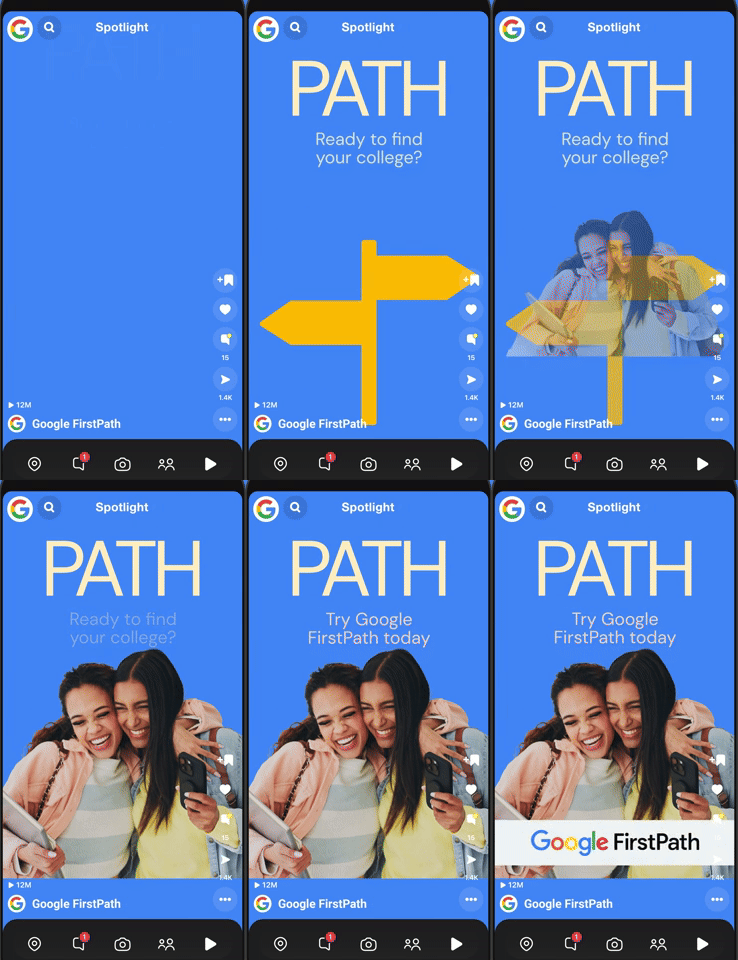
In creating the social media posts for Module 5, I used Adobe Express to design content that was visually cohesive with the brand’s identity, incorporating the established color palette, fonts and tone of voice. The Snapchat Ad was formatted as a vertical, story-style MP4 designed to grab attention in under seven seconds, using bold text overlays and a clear call-to-action (“Try Google FirstPath Today”). The Instagram Reel, also in MP4 format, focused on relatable student stories and employed motion graphics with short captions to guide viewers through the resource steps.
According to Aaker (2018), signature stories persuade most effectively when they resonate emotionally and feel authentic rather than promotional (p. 63). Both social media designs prioritize clarity, relatability, and emotional connection, reflecting this principle. By highlighting relatable student experiences, the posts mirror Aaker’s (2018) insight that “customer heroes can be effective because they lack a self-serving message…and their stories are often linked to the organization’s values or the brand’s value proposition” (p. 104). The posts extend the cohesive narrative arc established in earlier modules, reinforcing Google FirstPath’s positioning as a supportive and accessible resource.
The digital ads translated the campaign’s story into short-form, mobile-native formats, capturing attention where the target audience, primarily first-gen students, spends most of their time. (Mockups were presented as low-resolution GIFs for review, while the final MP4 files offered higher quality and smoother playback.) Consistent with Aaker’s (2020) argument that subcategories can drive differentiation by reframing a market space (Ch. 4, p. 66), these ads helped establish Google FirstPath as part of the new “Access Search” subcategory rather than as just another search tool.
Edits focused on backing up the content with citations about the target group and incorporating more details drawn from Aaker’s guidance on emotionally resonant and purpose-driven storytelling. These revisions strengthened the credibility of the campaign materials and aligned them more closely with Aaker’s (2018) emphasis on building trust and authenticity through evidence-based, audience-centered stories (p. 71).
To maximize engagement, the posts were scheduled strategically to coincide with peak mobile usage among students. Analytics and research indicate that late afternoon to early evening (5–8 PM EST) is a high-engagement window for this demographic. The Snapchat Ad was scheduled for Tuesdays at 6 PM EST, aligning with after-class downtime, while the Instagram Reel was scheduled for Thursdays at 7 PM EST, a time when students are most likely to engage with interactive, story-based content. This scheduling approach reflects Aaker’s (2018) observation that effective brand stories meet audiences in the contexts where they are most receptive (p. 55).
Together, these social media posts and ads demonstrate how platform-specific storytelling, guided by Aaker’s principles, can remain cohesive across formats, amplify the campaign’s core message, and strengthen the emotional bond between the brand and its target audience.
Digital Ad (JPG): The vertical still ad (shown on the left ➡️) serves as a retargeting ad through a yearlong contract with an ad agency. It will reach the unconverted target audience across their favorite platforms — Twitch, Discord, Reddit, BeReal, TikTok, Instagram, and YouTube — and follow them as they browse. The ad includes a prominent “Sign Up” call-to-action.
Snapchat Ad (MP4): A vertical, 5-second story ad features bold headlines and a clear “Try Google FirstPath today” call-to-action.
Instagram Reel (MP4): A 5-second reel series optimized for story placement with photography-focused creative, motion graphics and step-by-step resource tips.

Video Advertisement Script
The long-form video concept serves as the anchor narrative piece to deepen the brand’s story for presentations beyond the launch. It is a video-producer–ready script that could be handed off for storyboarding or voiceover work. It includes:
- Stills: Scenes of students interacting with both digital resources and real-life experiences.
- Time Stamps: Indicating pacing for key storytelling moments.
- Voice-Over Copy: Emphasizing empowerment and action.
- Uplifting Music: Drawing viewers into the narrative.
- Industry-Standard Storyboarding Abbreviations: Including Voice-Over (VO), Sound Effects (SFX), Audio/Visual Prompts (A/V), Exterior Location (EXT), Interior Location (INT), Close-Up (CU), Long-Shot (LS), Medium Shot (MS), Point-Of-View (POV), Background (BG), Zoom In (ZI), Zoom Out (ZO), Off-Screen Voice (OSV) and Dissolve (DIS).
David Aaker’s work on signature stories guided the design of the long-form video. Aaker (2018) argues that “interest, authenticity and relevance” persuade more effectively than facts alone (p. 10). Instead of focusing on product features, the video illustrates the first-gen student’s journey: late-night study struggles, small wins and eventual confidence, to humanize the brand’s role. This narrative reflects Google’s higher purpose of democratizing educational opportunity (Aaker, 2018, p. 13).
Authenticity invites viewers into the story (Aaker, 2018, p. 15), and using student voices in familiar spaces avoids a corporate tone while strengthening the emotional connection. The call to action: "Your path to college starts here,” aligns with Aaker’s (2018) guidance that purpose-driven messaging should inspire participation rather than merely inform (p. 48). This approach ensures the lived experience of students expresses Google FirstPath’s brand purpose.
By emphasizing a compelling narrative over promotional claims, the video supports the creation of a new, game-changing subcategory: guided navigation for first-gen students; a critical aspect of brand leadership in new categories (Aaker, 2020).
No revisions were needed for this deliverable. The script aligned from the outset with Aaker’s principles for crafting purpose-driven, authentic storytelling that inspires trust and participation.
Reflection
Throughout this digital storytelling campaign for Google FirstPath, Aaker’s frameworks shaped my core approach and rationale. I thought about Aaker’s concept of a “signature story,” and how it needs to feel real, pull people in and have a clear purpose, all while inspiring everyone involved (Aaker, 2018, p. 7). That really guided me as I tweaked the headline and call-to-action in the press release. I wanted them to do more than just inform; I wanted them to build trust and encourage participation.
Creating campaign elements required thinking strategically about differentiation and building loyalty, exactly as Aaker describes: “must-haves... are offerings or programs that provide a reason for customers to stay and avoid a reason to leave” (Aaker, 2020, p. 47). In this campaign, Google’s supportive navigator role became the signature must-have: a decision reinforced by audience insights and IMC theory. I found that echoing Aaker’s emphasis on authenticity and relevance meant an uncompromised connection to each review, be it peer, instructor or course feedback.
Signature stories are about more than branding; they motivate and unify content. As Aaker notes, “Content is king in the digital age, and stories are the key to content… They help brands stand out among the noise” (Aaker, 2018, p. 15). The podcast, digital ads and video script were built consciously to leverage story-driven messaging that communicates facts in “an engaging and humanistic way” (Aaker, 2018, p. 15).
Key Takeaways
- One major takeaway is that “facts presented in story form lead to greater changes in behavior or intentions than facts by themselves” (Aaker, 2018, p. 48). Integrating student testimonials and real user scenarios appears far more influential than just listing benefits.
- Another lesson is the strategic use of humor and brand personality. Aaker describes how “humor rewards the audience by entertaining” and increases attention and brand likability (Aaker, 2018, p. 86). Keeping the campaign’s approachable tone and slightly playful improves recall and comfort for the target audience.
- Aaker’s principle that “building and maintaining customer loyalty is not only created through the power of the ‘must-haves,’ and a communication program, but it then needs to be nurtured, energized and grown over time” (Aaker, 2020, p. 21) shaped the entire design of campaign elements. Sending out regular updates and keeping visuals consistent are important for keeping people interested in the campaign.
These ideas helped me understand how digital stories and integrated marketing, especially when built around a unique core message, create meaning and indelible connections with the brand (Aaker, 2018; Aaker, 2020). This project highlights how IMC-driven digital storytelling can transform abstract concepts into relatable and actionable stories.
References
Aaker, D. A. (2018). Creating signature stories: Strategic messaging that energizes, persuades, and inspires. Morgan James Publishing.
Aaker, D. A. (2020). Owning game, changing subcategories: Uncommon growth in the digital age. Morgan James Publishing.
Adobe Express. (n.d.). How to make a social media post with Express. Retrieved from https://www.adobe.com/express
Bryan, M., Capterton, S.A., Cooney, D. & Dudley, K. (2020, December). 2012 Postsecondary Students Longitudinal Study Postsecondary Education Transcript Study (PETS). National Center for Education Statistics. https://nces.ed.gov/pubs2021/2021176.pdf
Cardillo, A. (2025, August 15). How many Google searches are there per day? (August 2025). Exploding Topics. https://explodingtopics.com/blog/google-searches-per-day
Center for First-Generation Student Success. (2021). First-generation student demographics. NASPA. Retrieved from https://firstgen.naspa.org/reports/first-gen-landscape-analysis
Home | FirstGen Forward. (n.d.). https://www.firstgenforward.org/
Google for Education. (2025, September 18). Google for Education - Online resources for teachers & students. https://edu.google.com/
Hootsuite. (2024). How to Create a Brand Voice: A Guide for Social Media Marketers. https://blog.hootsuite.com/brand-voice/
Redford, J., Mulvaney Hoyer, K., & Ralph, J. (2017, September). First-generation and continuing-generation college students: A comparison of high school and postsecondary experiences (NCES 2018, 009). National Center for Education Statistics. https://nces.ed.gov/pubsearch/pubsinfo.asp?pubid=2018009
Thakur, T. (2025, July 22). Google Usage Statistics 2025: Key Trends and data Insights. SQ Magazine. https://sqmagazine.co.uk/google-usage-statistics/
The Pell Institute. (2024, May 2). Indicators of Higher Education Equity in the United States: 2022 Historical Trend Report. The Pell Institute. https://www.pellinstitute.org/pell-institute-indicators-2022/
US Census Bureau. (2025, July 11). Income in the United States: 2022. Census.gov. https://www.census.gov/library/publications/2023/demo/p60-279.html
Vogels, E.A., Gelles-Watnick, R., & Massarat, N. (2025, April 30). Teens, Social Media and Technology. Pew Research Center. https://www.pewresearch.org/internet/2022/08/10/teens-social-media-and-technology-2022/
Credits:
Adobe Stock Photos: (Computer keyboard and mouse from above) (Brightly lit concrete yellow staircase) (Close up of a drop oil on a yellow background) (Close up newspapers folded and stacked on yellow background on table) (Empty room interior design or yellow pedestal display on vivid background with blank stand) (Modern professional video camera on yellow background) (Person using a graphic pen tablet) (Princeton foliage) (Smartphone showing showing social media likes sticky notes yellow background) (Studio microphone on yellow background)